Ch. 11 The Muscular System
Martini - Fundamentals of Anatomy & Physiology 11th Edition
Martini, Nath, Bartholomew11th EditionFundamentals of Anatomy & PhysiologyISBN: 9780136874089Not the one you use?Change textbook
Chapter 11, Problem 16

Which four muscle groups make up the axial musculature?

Verified step by step guidance
1
Understand that the axial musculature refers to the muscles located along the central axis of the body, primarily responsible for movements of the head, neck, and trunk, as well as maintaining posture.
Identify that the axial muscles are grouped based on their location and function into four main categories.
The first group is the muscles of the head and neck, which include muscles involved in facial expression, mastication (chewing), and movements of the head.
The second group is the muscles of the vertebral column, which help in maintaining posture and moving the spine.
The third and fourth groups are the muscles of the thorax (including the muscles involved in respiration) and the muscles of the abdominal wall, which support the trunk and assist in breathing and core stability.

Verified video answer for a similar problem:

This video solution was recommended by our tutors as helpful for the problem above.
Video duration:
2m
Was this helpful?

Key Concepts

Here are the essential concepts you must grasp in order to answer the question correctly.

Axial Musculature

Axial musculature refers to the muscles located along the central axis of the body, primarily responsible for movements and support of the head, neck, and trunk. These muscles maintain posture and facilitate breathing and movements of the vertebral column.
Recommended video:
Guided course
4:50
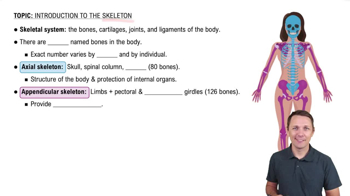
Skeletal System

Muscle Groups of the Axial Skeleton

The axial musculature is divided into four main groups based on their location and function: muscles of the head and neck, muscles of the vertebral column, muscles of the thoracic wall, and muscles of the abdominal wall. Each group plays a specific role in movement and stability.
Recommended video:
06:04
Functional Groups

Functions of Axial Muscle Groups

Each axial muscle group contributes to essential functions such as facial expression, chewing, head and neck movement, posture maintenance, respiration, and trunk movement. Understanding these functions helps identify and differentiate the four muscle groups.
Recommended video:
06:04
Functional Groups