Ch. 11 The Muscular System
Martini - Fundamentals of Anatomy & Physiology 11th Edition
Martini, Nath, Bartholomew11th EditionFundamentals of Anatomy & PhysiologyISBN: 9780136874089Not the one you use?Change textbook
Chapter 11, Problem 25

Why does a convergent muscle exhibit more versatility when contracting than does a parallel muscle?

Verified step by step guidance
1
Step 1: Understand the structure of a convergent muscle. A convergent muscle has fibers that spread out widely at the origin and converge toward a single tendon or insertion point, allowing the muscle fibers to pull in different directions depending on which fibers contract.
Step 2: Understand the structure of a parallel muscle. A parallel muscle has fibers that run parallel to the long axis of the muscle, producing force primarily in one direction along the length of the muscle.
Step 3: Analyze how the arrangement of muscle fibers affects the direction of pull. In a convergent muscle, because fibers are oriented in multiple directions, the muscle can change the direction of its pull by selectively contracting different groups of fibers.
Step 4: Compare this to the parallel muscle, where the uniform fiber orientation limits the muscle's ability to change the direction of force; it mainly contracts to shorten along one axis.
Step 5: Conclude that the versatility of a convergent muscle in contracting comes from its ability to generate force in multiple directions due to its fan-shaped fiber arrangement, unlike the parallel muscle which is more specialized for force in a single direction.

Verified video answer for a similar problem:

This video solution was recommended by our tutors as helpful for the problem above.
Video duration:
2m
Was this helpful?

Key Concepts

Here are the essential concepts you must grasp in order to answer the question correctly.

Muscle Architecture

Muscle architecture refers to the arrangement of muscle fibers relative to the force-generating axis. Convergent muscles have fibers that spread out from a broad origin and converge on a single tendon, allowing varied directions of pull. Parallel muscles have fibers aligned in the same direction, producing force mainly along one line.
Recommended video:
Guided course
2:00
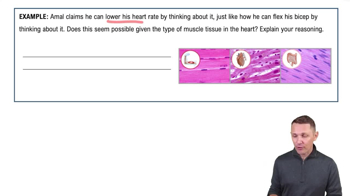
Introduction to Muscles and Muscle Tissue Example 1

Versatility in Muscle Contraction

Versatility in muscle contraction means the ability to generate force in multiple directions or perform different movements. Convergent muscles can activate different fiber groups independently, enabling diverse movement patterns, while parallel muscles contract uniformly, limiting their range of action.
Recommended video:
Guided course
4:53
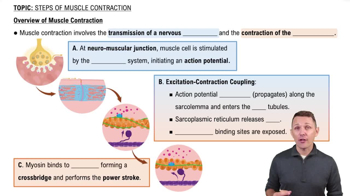
Overview of Muscle Contraction

Force Generation and Fiber Recruitment

Force generation depends on how muscle fibers are recruited and oriented. In convergent muscles, selective activation of fibers allows modulation of force direction and magnitude. Parallel muscles recruit fibers in a uniform direction, resulting in consistent but less adaptable force output.
Recommended video:
14:36
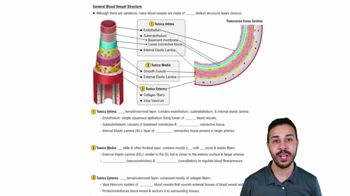
General Blood Vessel Structure