
Ch. 15 Sensory Pathways and the Somatic Nervous System
Martini - Fundamentals of Anatomy & Physiology 11th Edition
Martini, Nath, Bartholomew11th EditionFundamentals of Anatomy & PhysiologyISBN: 9780136874089Not the one you use?Change textbook
Chapter 15, Problem 14

Differentiate between a tonic receptor and a phasic receptor.

Verified step by step guidance
1
Step 1: Understand that sensory receptors are specialized cells or nerve endings that respond to specific stimuli and convert them into nerve impulses.
Step 2: Define a tonic receptor as a type of sensory receptor that responds continuously to a stimulus as long as it is present, providing a sustained response over time.
Step 3: Define a phasic receptor as a sensory receptor that responds rapidly at the onset of a stimulus but quickly adapts and decreases its response if the stimulus remains constant.
Step 4: Compare the two by noting that tonic receptors are important for detecting the duration and intensity of a stimulus, while phasic receptors are important for detecting changes or the beginning and end of a stimulus.
Step 5: Summarize by highlighting that tonic receptors maintain a steady signal during prolonged stimulation, whereas phasic receptors signal changes and adapt quickly to constant stimuli.

Verified video answer for a similar problem:

This video solution was recommended by our tutors as helpful for the problem above.
Was this helpful?

Key Concepts

Here are the essential concepts you must grasp in order to answer the question correctly.

Tonic Receptors

Tonic receptors are sensory receptors that respond continuously to a stimulus as long as it is present. They maintain a steady rate of firing, providing information about the duration and intensity of the stimulus, such as pain or muscle stretch.
Recommended video:
1:17
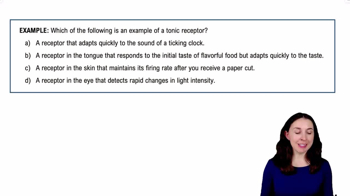
Adaptation of Sensory Receptors Example 1

Phasic Receptors

Phasic receptors respond rapidly at the onset of a stimulus but quickly decrease their firing rate even if the stimulus continues. They are important for detecting changes or the beginning and end of a stimulus, like touch or pressure.
Recommended video:
1:17
Adaptation of Sensory Receptors Example 1

Adaptation in Sensory Receptors

Adaptation refers to the decrease in receptor sensitivity over time when exposed to a constant stimulus. Tonic receptors adapt slowly or not at all, while phasic receptors adapt quickly, allowing the nervous system to focus on new or changing stimuli.
Recommended video:
1:17
Adaptation of Sensory Receptors Example 1