Ch. 15 The Urinary System
Marieb - Essentials of Human Anatomy & Physiology 13th Edition
Marieb13th EditionEssentials of Human Anatomy & PhysiologyISBN: 9780135624340Not the one you use?Change textbook
Chapter 15, Problem 3

More than one choice may apply.
Urine passes through the ureters by which mechanism?
a. Ciliary action
b. Gravity alone
c. Peristalsis
d. Suction

Verified step by step guidance
1
Understand the anatomy of the ureters: The ureters are muscular tubes that transport urine from the kidneys to the bladder. They are lined with smooth muscle and are not equipped with cilia, which are hair-like structures found in other parts of the body like the respiratory tract.
Clarify the role of gravity: While gravity can assist in the movement of fluids, it is not the primary mechanism for urine transport through the ureters. This is because the ureters function effectively even when a person is lying down or in a non-upright position.
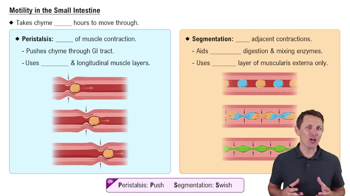
Explain peristalsis: Peristalsis is the rhythmic contraction and relaxation of smooth muscle that propels substances through tubular structures in the body, such as the ureters. This mechanism actively moves urine from the kidneys to the bladder, regardless of body position.
Evaluate suction: Suction is not a mechanism used by the ureters to transport urine. Suction typically refers to pressure differences that draw substances into a space, which is not applicable to the ureters' function.
Conclude the correct mechanisms: Based on the anatomy and physiology of the ureters, peristalsis is the primary mechanism for urine transport. Gravity may play a minor role but is not the sole or primary method.

Verified video answer for a similar problem:

This video solution was recommended by our tutors as helpful for the problem above.
Video duration:
2m
Was this helpful?

Key Concepts

Here are the essential concepts you must grasp in order to answer the question correctly.

Ureters and Urine Transport

The ureters are muscular tubes that transport urine from the kidneys to the bladder. This transport is essential for the urinary system's function, ensuring that waste products are efficiently removed from the body.
Recommended video:
02:37
Active Transport

Peristalsis

Peristalsis is a series of wave-like muscle contractions that move food and liquids through the digestive tract and other tubular structures, including the ureters. This involuntary action is crucial for the movement of urine, as it helps propel it toward the bladder.
Recommended video:
Guided course
3:06
Motility in the Small Intestine

Role of Gravity

While gravity can assist in the movement of urine, especially when the body is in an upright position, it is not the sole mechanism. The combination of peristalsis and gravity works together to ensure efficient urine flow through the ureters.
Recommended video:
4:58
Introduction to Energy