Name the eight bones of the cranium.
Ch. 5 The Skeletal System

Marieb13th EditionEssentials of Human Anatomy & PhysiologyISBN: 9780135624340Not the one you use?Change textbook
Chapter 5, Problem 12f
Match the bone markings listed on the right with their function listed on the left.
1. Attachment site for muscle or ligament
2. Forms a joint surface
3. Passageway for vessels or nerves
f. Tuberosity
Verified step by step guidance1
Understand the function of a tuberosity: A tuberosity is a large, rounded projection on a bone, often roughened, and serves as an attachment site for muscles or ligaments.
Review the options provided in the problem: The functions listed are 'Attachment site for muscle or ligament,' 'Forms a joint surface,' and 'Passageway for vessels or nerves.'
Match the tuberosity to its correct function: Since a tuberosity is primarily an attachment site for muscles or ligaments, it corresponds to option 1.
Eliminate the other options: A tuberosity does not form a joint surface (option 2) or serve as a passageway for vessels or nerves (option 3).
Conclude that the correct match for 'f. Tuberosity' is '1. Attachment site for muscle or ligament.'

Verified video answer for a similar problem:
This video solution was recommended by our tutors as helpful for the problem above.
Video duration:
1mWas this helpful?
Key Concepts
Here are the essential concepts you must grasp in order to answer the question correctly.
Bone Markings
Bone markings are specific features on the surface of bones that serve various functions, including attachment points for muscles and ligaments, joint formation, and pathways for nerves and blood vessels. Understanding these markings is crucial for identifying how bones interact with other structures in the body.
Recommended video:
Guided course
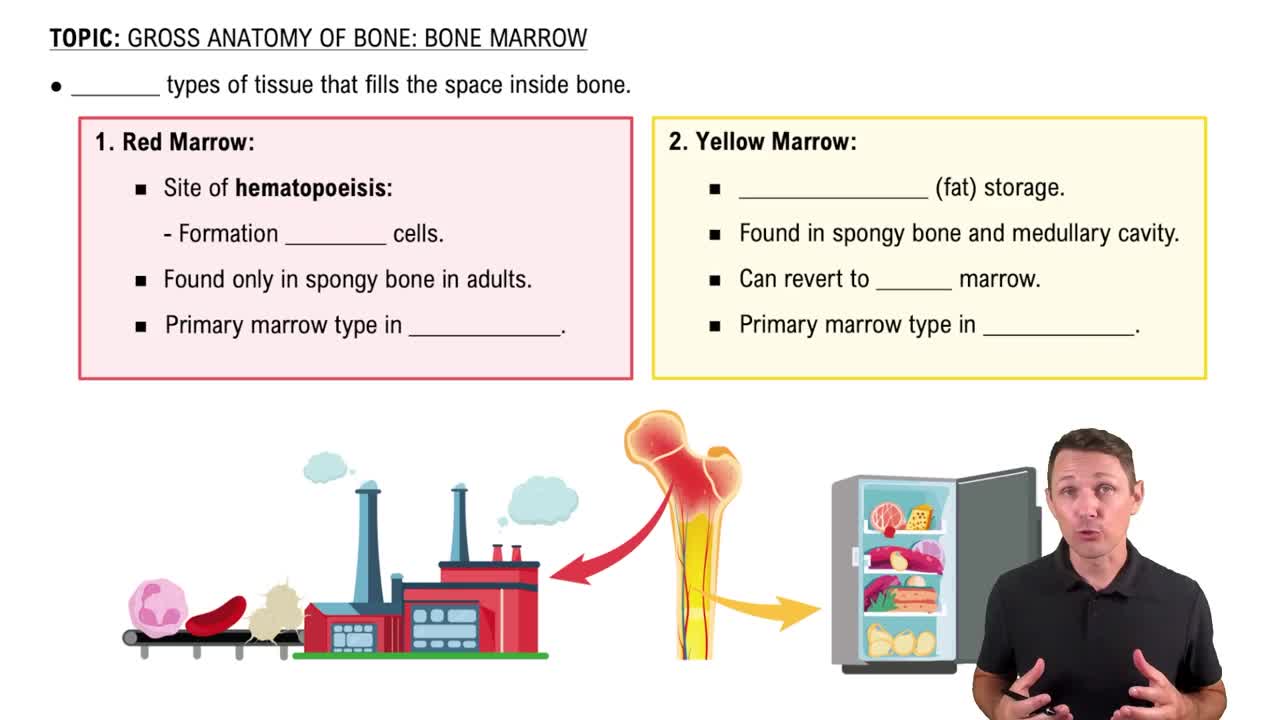
Bone Marrow
Muscle and Ligament Attachment
Attachment sites for muscles and ligaments are areas on bones where these tissues connect, allowing for movement and stability. Examples include tuberosities and processes, which provide leverage and support for muscular action, essential for understanding biomechanics.
Recommended video:
Guided course
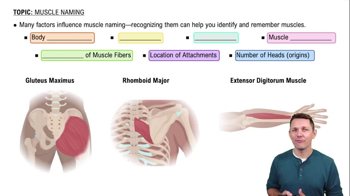
Muscle Naming
Joint Surfaces
Joint surfaces are the areas of bones that come into contact with each other to form joints. These surfaces are often smooth and shaped to facilitate movement and reduce friction, playing a vital role in the function of the skeletal system and overall mobility.
Recommended video:
Cell Surface Receptors
Related Practice
Textbook Question
1171
views
Textbook Question
Match the bone markings listed on the right with their function listed on the left.
1. Attachment site for muscle or ligament
2. Forms a joint surface
3. Passageway for vessels or nerves
e. Facet
683
views
Textbook Question
What facial bone forms the chin? The cheekbone? The upper jaw? The bony eyebrow ridges?
1514
views
Textbook Question
Match the bone markings listed on the right with their function listed on the left.
1. Attachment site for muscle or ligament
2. Forms a joint surface
3. Passageway for vessels or nerves
c. Foramen
610
views
Textbook Question
Match the bone markings listed on the right with their function listed on the left.
1. Attachment site for muscle or ligament
2. Forms a joint surface
3. Passageway for vessels or nerves
d. Process
473
views
Textbook Question
What is yellow marrow? How do spongy and compact bone look different?
1218
views