Ch. 19 Blood
Martini - Fundamentals of Anatomy & Physiology 11th Edition
Martini, Nath, Bartholomew11th EditionFundamentals of Anatomy & PhysiologyISBN: 9780136874089Not the one you use?Change textbook
Chapter 19, Problem 26

Relate the structure of hemoglobin to its function.

Verified step by step guidance
1
Understand that hemoglobin is a protein found in red blood cells responsible for transporting oxygen from the lungs to tissues and returning carbon dioxide from tissues to the lungs.
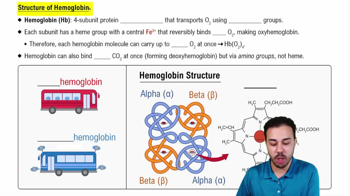
Recognize that hemoglobin has a quaternary structure composed of four polypeptide chains (two alpha and two beta chains), each containing a heme group with an iron (Fe2+) atom at its center.
Explain that the iron atom in each heme group binds reversibly to one oxygen molecule (O2), allowing each hemoglobin molecule to carry up to four oxygen molecules.
Discuss how the quaternary structure allows cooperative binding, meaning the binding of oxygen to one heme group increases the affinity of the remaining heme groups for oxygen, enhancing oxygen uptake and release efficiency.
Highlight that the structural features of hemoglobin, including its subunit arrangement and heme groups, enable it to efficiently pick up oxygen in the lungs and release it in tissues where oxygen concentration is lower.

Verified video answer for a similar problem:

This video solution was recommended by our tutors as helpful for the problem above.
Was this helpful?

Key Concepts

Here are the essential concepts you must grasp in order to answer the question correctly.

Hemoglobin Structure

Hemoglobin is a protein composed of four polypeptide chains, each containing a heme group with an iron atom. This quaternary structure allows it to bind oxygen molecules efficiently. The arrangement of subunits facilitates cooperative binding, essential for its function.
Recommended video:
6:45
Structure of Hemoglobin

Oxygen Binding and Transport

Hemoglobin's primary function is to transport oxygen from the lungs to tissues. The iron in the heme groups binds oxygen reversibly, enabling hemoglobin to pick up oxygen in high-oxygen environments and release it where oxygen is low.
Recommended video:
9:16
Outcomes of Antibody Binding to Antigen

Cooperative Binding and Allosteric Regulation

Hemoglobin exhibits cooperative binding, meaning the binding of oxygen to one subunit increases the affinity of others. This allosteric effect allows efficient oxygen uptake and release, adapting to varying oxygen demands in different tissues.
Recommended video:
9:16
Outcomes of Antibody Binding to Antigen