Ch. 14 The Digestive System and Body Metabolism
Marieb - Essentials of Human Anatomy & Physiology 13th Edition
Marieb13th EditionEssentials of Human Anatomy & PhysiologyISBN: 9780135624340Not the one you use?Change textbook
Chapter 14, Problem 5

More than one choice may apply.
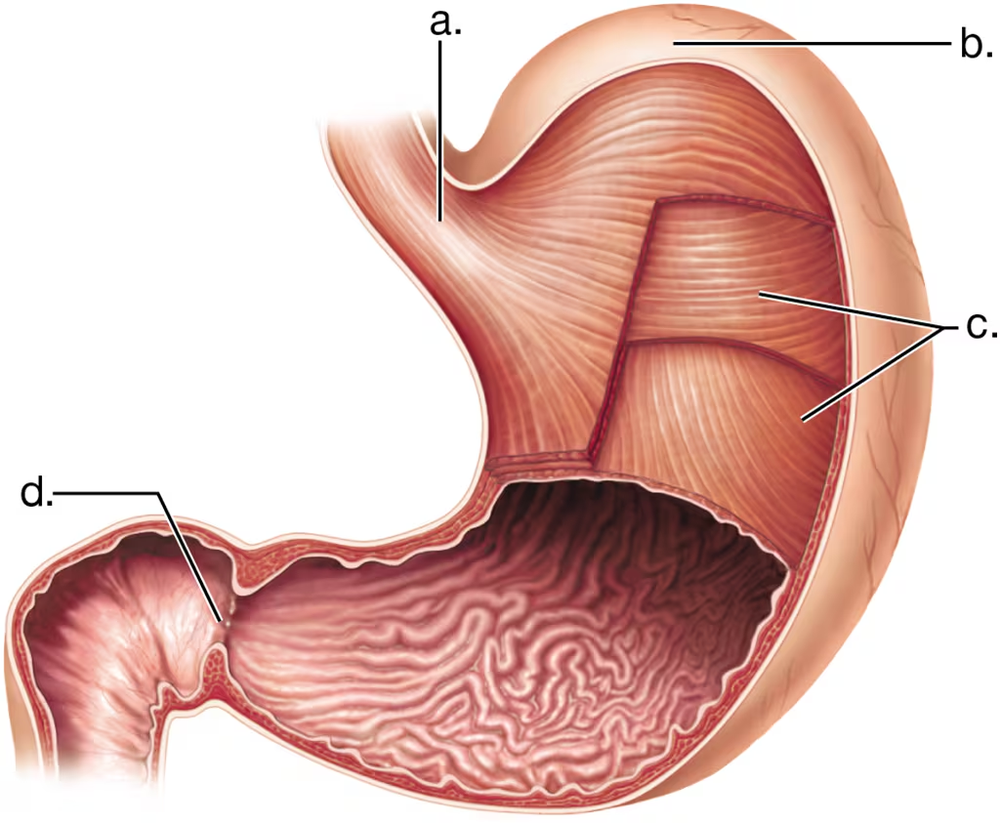
Where in the stomach do the strongest peristaltic waves occur?
Illustration of the stomach's interior, highlighting areas of strong peristaltic waves with labeled sections.

Verified step by step guidance
1
Understand the concept of peristalsis: Peristalsis refers to the rhythmic contraction and relaxation of muscles in the gastrointestinal tract that helps move food through the digestive system. In the stomach, these waves are responsible for mixing and propelling food toward the small intestine.
Identify the regions of the stomach: The stomach is divided into four main regions: the cardia (near the esophagus), the fundus (upper portion), the body (middle portion), and the pylorus (lower portion near the small intestine). Each region has distinct functions and muscle activity.
Recognize where peristaltic waves are strongest: The strongest peristaltic waves occur in the pyloric region of the stomach, particularly near the pyloric antrum. This area has thicker muscular walls to generate powerful contractions that help push food through the pyloric sphincter into the duodenum.
Relate the function of the pyloric region to digestion: The pyloric region is crucial for mechanical digestion and regulating the passage of chyme (partially digested food) into the small intestine. Strong peristaltic waves ensure efficient mixing and propulsion.
Review the options provided in the question: Match the anatomical regions of the stomach to the choices given in the question. Select the option(s) that correspond to the pyloric region or antrum, as this is where the strongest peristaltic waves occur.

Verified video answer for a similar problem:

This video solution was recommended by our tutors as helpful for the problem above.
Video duration:
1m
Was this helpful?

Key Concepts

Here are the essential concepts you must grasp in order to answer the question correctly.

Peristalsis

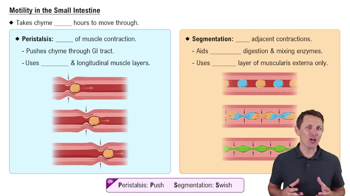
Peristalsis is a series of wave-like muscle contractions that move food through the digestive tract. In the stomach, these contractions help mix food with gastric juices and propel it toward the small intestine. Understanding peristalsis is crucial for identifying where the strongest waves occur, as they are responsible for the mechanical digestion of food.
Recommended video:
Guided course
3:06
Motility in the Small Intestine

Stomach Anatomy

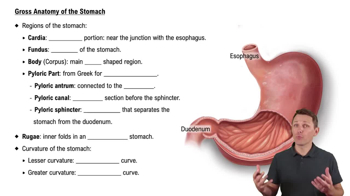
The stomach is divided into several regions: the fundus, body, and pylorus. Each region has distinct functions and muscle arrangements that influence peristaltic activity. Recognizing the anatomy of the stomach helps in pinpointing where the strongest peristaltic waves occur, typically in the pyloric region, which prepares food for entry into the small intestine.
Recommended video:
Guided course
5:42
Gross Anatomy of the Stomach

Gastric Motility

Gastric motility refers to the movements of the stomach that facilitate digestion and the passage of food. It includes both peristaltic waves and other types of contractions. Understanding gastric motility is essential for determining the areas of the stomach where these movements are most vigorous, which is important for effective digestion and nutrient absorption.
Recommended video:
Guided course
3:06
Motility in the Small Intestine